Professor Henry Srebrnik

Professor Henry Srebrnik

Monday, June 28, 2021

Iran’s New President Poses a Challenge to the West

 By Henry Srebrnik, [Moncton NB] Times & Transcript

The sham June 18 Iranian presidential election, where the candidates had to be vetted as ideologically correct by the country’s real rulers, the Shia theocracy, resulted in the victory of hardliner Ebrahim Raisi, himself a cleric. No surprise. 

Power lies not with the president, but in the office of the Supreme Leader, Ayatollah Ali Khamenei. He controls the Islamic Revolutionary Guard Corps, the media channels, the clerics and foreign policy. 

Some 600 hopefuls, including 40 women, had been winnowed down to seven candidates, all men. Many Iranians saw this latest election as having been engineered for Raisi to win and shunned the poll.  

Official figures showed voter turnout was the lowest ever for a presidential election, at 48.8 per cent, compared to more than 70 per cent for the previous vote in 2017. For what it’s worth, Raisi won almost 62 per cent of the votes. 

Raisi, who in 2017 lost to more moderate Hassan Rouhani, was the preferred candidate of Ayatollah Khamenei, who in March 2019 had appointed him as head of Iran’s judiciary, where he launched a “war on corruption.” He has even been seen as a possible successor to Khamenei. 

Raisi was already notorious for his role in the mass execution of thousands of prisoners in the late 1980s. He is said to have been one of four judges who oversaw secret death sentences for about 5,000 prisoners in jails near Tehran, according to Amnesty International. It says the location of the mass graves where the men and women were buried is being systematically concealed by the Iranian authorities.   

In 2009, he defended the executions of a dozen people who took part in the protests that followed President Mahmoud Ahmadinejad’s reelection.  

Under his presidency, Iran will seek to reinforce a puritanical system of Islamic government, possibly meaning more controls on social activities, fewer freedoms and jobs for women, and tighter control of social media and the press. 

The regime will also, according to analysts, look to China to help the economy out of its deep crisis. Raisi will zealously stamp out nationwide uprisings, and those remain a possibility after the 2019-2020 fuel price protests. 

Will Iran continue to develop a nuclear arsenal, something it denies but which most observers think is progressing?  

Iran on June 15 announced that it has produced 6.5 kilograms of uranium enriched to 60 per cent purity and 108 kilograms of uranium enriched to 20 per cnt purity in five months.  

International Atomic Energy Agency (IAEA) Director General Rafael Grossi contended May 24 that Iran was enriching uranium at purity levels that “only countries making bombs are reaching.” He stated that it was Iran's “sovereign right” to develop its program but added: “This is a degree that requires a vigilant eye.” 

A three-month monitoring deal between Iran and the IAEA has expired, so the agency no longer has access to Iran’s nuclear data. 

U.S. President Joe Biden’s Secretary of State Antony Blinken and National Security Adviser Jake Sullivan will be uncomfortable with Raisi as president. Indirect talks with Iran over reviving the Joint Comprehensive Plan of Action (JCPOA), Barack Obama’s 2015 nuclear deal that was abrogated by Donald Trump, may face more uncertainty.  

Yet Biden seems unwilling to threaten Tehran with more sanctions and military action even as Iran keeps enriching uranium and developing more advanced centrifuges. His administration may have to admit that Tehran under Raisi has no intention of making any nuclear deal “longer, stronger, broader” as Blinken once described a follow-up agreement to the JCPOA, without sanctions relief. 

Israel is the country most likely to derail the administration’s hopes. Its opposition to the nuclear deal is much deeper and broader today than it was in 2015. Israel continues to conduct covert actions inside Iran, such as its sabotage of a power generator at the Iranian nuclear enrichment facility in Natanz in April. 

Many Sunni Arab states also fear Iran’s imperialism via proxy militias in Gaza, Iraq, Lebanon, Syria and Yemen and see America as a declining power. 

However, major Israeli military action against Iran’s nuclear infrastructure would surely cause a rift between the Jewish state and the Democratic Party, and with Benjamin Netanyahu no longer prime minister, this may be less likely.

Monday, June 21, 2021

Morocco is Moderating Under Islamist Party's Rule

 By Henry Srebrnik, [Moncton NB] Times & Transcript

In the mid-1960s, the Islamic Youth in Morocco, the predecessor to the Movement for Unity and Reform (MUR) and the Party for Justice and Development (PJD), was a violent movement targeting the Moroccan monarchy.

However, a major transformation took place when a large number of MUR leaders and cadres joined the PJD, which then entered the electoral arena. Today it is legitimising the same Moroccan regime it once aimed to bring down by participating in the party system.

It contested the legislative elections of 1997 and 2002, winning 14 and 44 seats, respectively, in the 326-seat parliament. In contrast to other Islamist parties at the time, the PJD formally recognized the Moroccan monarchy.

In the next election, held in September of 2007, the PJD won 46 out of 325 seats, narrowly losing to the country’s leading political formation, the Independence Party.

The PJD increasingly adopted a moderate rhetoric that allowed it to proceed along a pragmatic, gradualist, and non-confrontational stance with the monarchy.

The Arab revolutions of 2011 also hit Morocco, with thousands of Moroccans joining nationwide protests in February. They demanded that King Muhammad VI hand over some of his powers to a newly elected government and make the justice system more independent.

A national referendum took place on July 1, 2011. A new constitution now ensures that the prime minister is selected from the party that received the most votes in elections, rather than chosen by the king.

This enabled the PJD, which won 107 seats in the November 2011election, to form a coalition with three parties that had been part of previous governments, headed by PJD leader Abdelilah Benkirane, who became prime minister.

In 2016, the party increased its numbers in parliament to 125 seats, with Saadeddine Othmani, Benkirane’s successor as leader of the party, as prime minister. He heads a coalition of six parties.

In February 2013, Benkirane stated that the PJD is an Islamist party that shares some of the same ideologies as the Muslim Brotherhood but operates “with different principles.” Benkirane denied that the PJD belongs to the global Brotherhood movement, instead claiming that each Islamist movement has “its own political thought.”

The PJD again denied affiliation with the Brotherhood in January 2015 when the PJD was publicly accused of attempting to “Islamize Moroccan society.” Benkirane reaffirmed the PJD’s Islamist agenda, but claimed that its philosophy differed from that of the Brotherhood. There was no organizational relationship between the two, he insisted.

The party considers Moroccan society as Muslim, as opposed to radical Islamists, for whom the members of any society not ruled by God’s law cannot be considered Muslim.

Since the 1990s, the PJD has paid attention to the experiences of other Islamist political parties and learned that it is safer to follow a pragmatic, gradual and progressive strategy rather than to engage in deep and comprehensive reforms.

Therefore, the PJD’s inclusion process and non-confrontational strategy is marked not only by domestic constraints but also by what the party has learned from the region, especially from its counterparts in Algeria in the 1990s, where events led to a horrific civil war.

This “Moroccan exception” has been attributed to the intimate relationship between Islam and the monarchy, to the unifying role of the king as both political arbiter and Commander of the Faithful, and to Muhammad VI’s own reformist style.

The party was opposed to the king’s recent normalization of relations with Israel, however, reiterating its “firm position against the Zionist occupation.” Some even urged Prime Minister Othamni, the party’s secretary-general, to resign from both posts. 

An element of the deal was American recognition of Morocco’s claim to sovereignty over the Western Sahara. The decades-old territorial dispute has pitted Morocco against the Algeria-backed Polisario Front, which seeks to establish an independent state. This did find favour with the PJD.

As Morocco prepares for general elections, scheduled for September this year, the PJD faces ideological divides over these issues. In March, former prime minister Abdelilah Benkirane suspended his membership in the party.

Foreign Affairs Minister Nasser Bourita has conveyed Morocco’s concerns over the recent warfare between Hamas and Israel and the PJD demanded the closure of the Israeli liaison office in the capital, Rabat.

Monday, June 14, 2021

Russia is Becoming a Precarious Petrostate

By Henry Srebrnik, [Moncton NB] Times & Transcript

Prior to meeting U.S. president Joe Biden in Geneva June 16, Russian president Vladimir Putin has contended that the United States is trying to stifle Russia’s economy. “It wants to contain our development and publicly talks about it,” he told the Channel One television station June 4. But the country’s economic problems are mainly domestic in nature.

How has Russia fared in the decades since Putin assumed power? The post-Soviet Russian political system was supposed to develop liberal market democracy but has become increasingly dictatorial and illiberal. A form of capitalism has been built in which the market plays a role in the distribution of resources, but this is a political capitalism in which the economy is dominated by elite political interests, which take “rent” – essentially unearned profits – from the economy and use them to buy support.

The new authoritarianism in Russia is different to that of the Soviet past. The ruling Communist Party of the Soviet Union (CPSU) has been replaced by United Russia, but this is a highly personalized party loyal to President Putin; it is not a political force in its own right. Repression still exists but is less systematic than it was for most of the Soviet era.

The first decade of post-Soviet life under Boris Yeltsin had been one of dizzying opportunities for some Russians. But for the vast majority, it was a nasty fight for survival. Russia experienced a catastrophic decline of its economy. Industries were closing down, life expectancy was dropping, and people were becoming homeless and malnourished.

Yeltsin had created uncontrolled monopolies, making the oligarchs who had acquired these assets extremely wealthy. The country was in a downward spiral by the time he left office at the end of 1999.

Putin spent much of his early years as president rebuilding a “power vertical,” subordinating executive powers and the regions to one system of command and control. He intimidated into submission, drove into exile, or imprisoned oligarchs who tried to convert their vast wealth into political power. This happened concurrently with a Soviet-style institutional rebirth, doubling state control over the economy, and returning secret services to the centre stage of Russian life.

The concept of “sovereign democracy,” introduced by Vladislav Surkov, was a signal that Russia was beginning to pivot away from the west. The last few years have seen an increasingly ideological politics developed based on what Putin calls “traditional Russian values” -- respect for family, patriotism, intolerance of social difference, Orthodox Christianity, and hostility to liberalism. The Russian Orthodox Church stood at the centre of this new conservative pact, with Patriarch Kirill rejoicing Putin as a “miracle of God.”

One of the undeniable achievements of Putin’s rule was a massive reduction in absolute poverty. That was achieved on the back of historically high oil prices, an early reformist agenda and several years of high growth. Over the 10 years from 1999 to 2008, Russian GDP increased by 94 per cent. More recent years have not been as good, though.

Many analysts consider Russia to be a “petrostate,” dependent on oil and gas revenues exported abroad. Russia is ranked third in the world for oil production, producing 12.1 per cent of the world’s oil, some 11.5 million barrels per day, and exporting $72.37 billion dollars worth in 2020.

The three major companies include market leader Rosneft, which is fully owned by the Russian government, Lukoil, and Gazprom. Much of the industry is state-owned and controlled. Putin has a grip on the industry and directs it to his own ends.

Such dependence is fraught with economic danger. For example, when the price of oil declined in 2014 the Russian ruble fell in value by 59 per cent relative to the U.S. dollar in just six months.

Most oil and gas exports go to Europe, so Russia is mostly dependent on the European market for export revenues. But this is a cause for concern because Europe is striving towards a future of clean and renewable energy and trying to phase out the use of fossil fuels.

Sooner or later, Russia will have to diversify and become less tied to oil and gas exports, if it wishes to remain a major player in the global economy.

Tuesday, June 08, 2021

The Pandemic’s Effect in America Varies

 By Henry Srebrnik, [Charlottown, PEI] Guardian

This pandemic is different from the Great Depression of the 1930s. The Dow Jones Industrial Average has risen, and the wealthiest in the United States have seen their riches greatly increase. According to a study by 24/7 Wall St., the net worth of America’s 614 billionaires grew by a collective $931 billion during the first seven months of the pandemic.

Last year, Democratic presidential aspirant Andrew Yang remarked that “Amazon is like a giant spaceship” sucking up retail jobs and destroying smaller businesses. Jeff Bezos, its owner, is worth some $200 billion.

Amazon Unbound: Jeff Bezos and the Invention of a Global Empire by Brad Stone shows how the company increasingly wields its enormous scale against potential rivals. Amazon contributes to individual inequality by paying salaries so low that more than 4,000 warehouse workers in nine states are eligible for federal food-stamp subsidies.

Big Tech execs have especially profited. For example, Twitter founder Jack Dorsey’s personal wealth grew by $7.8 billion. Obviously, things are good for the billionaire class.

The most recent World Inequality Database shows the top one per cent of Americans control just under 35 per cent of the nation’s personal wealth – more than China’s 29.6 per cent.

Societies now recognize that workers in essential services, such as supermarkets, warehouses, delivery services, utilities maintenance, and above all health, have been taken for granted and underpaid for too long.  

 “Martin Luther King Jr. predicted this moment,” wrote Gene Sperling, the national economic adviser to presidents Bill Clinton and Barack Obama, in the April 24, 2020 New York Times, referring to King’s support for the 1968 Memphis sanitation workers’ strike.

“One day,” King told them, “our society will come to respect the sanitation worker if it is to survive, for the person who picks up our garbage, in the final analysis, is as significant as the physician, for if he doesn’t do his job, diseases are rampant. All labor has dignity.”

Yet we are forced to confront the dissonance between calling workers “essential” and “heroes” while accepting the fact of their limited wages, benefits, and inability to organize. Many nursing, psychiatric and home health aides aren’t offered even a single day of paid sick leave.

Why have we privileged, not just billionaires, but white-collar and so-called “knowledge” workers?

Because the essence of modern meritocracy is the link between education and work, so one of its key social manifestations is the phenomenon of credentialism – the belief that academic or other formal qualifications are the best measure of a person’s intelligence or ability to do a particular job. This belief has undermined the dignity associated with other forms of work requiring less in the way of cognitive thinking skills.

In The Cult of Smart: How Our Broken Education System Perpetuates Social Injustice, Fredrik DeBoer contends that a “system that doles out wealth and hardship based on academic ability is inherently and forever a rigged game.” Academics who help define what it means to be progressive live lives of great privilege, thanks to the very meritocratic system that creates inequality.

The Merit Myth by Anthony P. Carnevale, Peter Schmidt and Jeff Strohl sees elite colleges as gatekeepers that shut out “large swaths of the American population from access to power, opportunity, and wealth.”

This may help us understand why so many manual workers have turned to right-wing politics. The anthropologist Ralph Linton in his 1936 The Study of Man pointed to the difference between “achieved” identity and “ascribed” identity.

The institutions that have historically accepted you as a member unconditionally – family, church, nation – are all weakened in a more mobile and more individualistic society, he wrote. Achieved identities based on educational and career success have eclipsed ascribed identities based on attachment to place and group.

In his book Head, Hand, Heart: The Struggle for Dignity and Status in the 21st Century, British writer David Goodhart takes up Linton’s point, and makes a case for reviving the status of work outside the “knowledge economy,” especially in the age of automation.

Can we really argue that the work of a junior account manager is more useful than that of a bus driver? asks Goodhart. Or, indeed, more skilled?


Monday, June 07, 2021

Unlikely Coalition Could Mean Netanyahu's End

By Henry Srebrnik, [Moncton, NB] Times & Transcript

National elections were held in Israel on March 23 to elect the 120 members of the Knesset, Israel’s unicameral parliament. Due to Israel’s proportional representation party list electoral system, there are no constituency seats and parties are simply allocated seats based on their percentage of the total nationwide vote.

This dysfunctional system has resulted in no party ever coming close to winning a majority of seats, and all governments have been coalitions since the founding of the state in 1948. This was the fourth election in two years, as election after election failed to break the country’s political deadlock.

With 13 parties winning mandates, as they are called, to the Knesset, Prime Minister Benjamin Netanyahu’s right-wing Likud came first – but with just 30 seats, less than half needed for a majority of 61. While his is a long-established party, in recent years a bewildering number of other groups have emerged, gained popularity, and disappeared soon afterwards.

In fact the once mighty Labour Party, which governed the Jewish state for its first decades, won a mere seven seats, good for sixth place.

In order to dethrone Netanyahu, Israel’s longest-serving prime minister, his opponents have created an eight-headed monster, a puzzling grouping ranging from the left to the far right, including an Arab party. They are united on little, other than taking power. Some are themselves former former protégés of Netanyahu’s Likud-led governments.

Coming second was Yesh Atid, a centrist party founded in 2012 by former journalist Yair Lapid. He created Yesh Atid as a “fusionist third-way” party between Israel’s traditional left and right.

Despite that, this self-described “change government” will be led until 2023 by Naftali Bennett, though his party, Yamina, won just seven seats. A far-right ideologue and former Netanyahu ally, he opposes a Palestinian state.

Bennett and centrist Yesh Atid leader Yair Lapid agreed to a rotation scheme, with Bennett becoming prime minister for the first two years, followed by Lapid. The latter will serve as foreign minister until the two swap roles.

Odd as this may seem, it is not without precedent. An indecisive election held in 1984, in which the Labour Party-led Alignment and the Likud won 44 and 41 seats, respectively, led to a national unity government.

Labour’s Shimon Peres held the post of prime Minister until September 1986, when Likud’s Yitzhak Shamir took over.

Also part of the alliance is the left-wing Meretz, led by Nitzan Horowitz, which holds six mandates; Avigdor Lieberman’s nationalist Israel Beiteinu, with seven seats; Benny Gantz’s liberal Kahol Lavan with eight; and the new centre-right Tikva Hadasha, created last year by Gideon Sa’ar, with six.

Completely unprecedented, though, is the formal inclusion of an Arab party in a governing coalition – all the more so because the United Arab List, known as Ra’am, is an avowedly Islamist organization.

It is the political wing of the Southern Branch of the Islamic Movement in Israel, considered more moderate than the Northern Branch, which was banned by the Israeli government in November 2015 due to close ties with Hamas and the Egyptian-founded Muslim Brotherhood.

Ra’am won four seats in this election. On June 2, after holding negotiations with Lapid and Bennett, its leader, Mansour Abbas, decided to back a non-Netanyahu government. He has reportedly secured major policy victories for Israel’s Arab sector in return.

The political struggles in Israel have reached this state because the actors are focused not on issues but on personal, sectorial, factional, and party-based considerations. The Israeli right and left are equally to blame for this process.

Opportunism reigns and national interests have been relegated to the margins of political discourse, at a time when Israel is under increased pressure from Iran and its proxies.

Is this a first step towards a bi-national state, where politics becomes sectarian? It becomes an even more pressing matter following last month’s violence between Arabs and Jews within the country.

Meanwhile, Netanyahu, as opposition leader, will be poised to pounce on this shaky new governing coalition. He accused Bennett of carrying out “the fraud of the century,” referring to the Yamina leader’s earlier promises not to join forces with Lapid.

This unlikely alliance still needs to be confirmed by parliament to take power. Is yet a fifth election on the horizon?


Monday, May 31, 2021

Israel Faces Grave Internal Problems

By Henry Srebrnik, [Moncton, NB] Times & Transcript

While much of the world’s focus earlier this month was on the war between Hamas and Israel, something else was happening within Israel itself that may pose a potentially greater long-term problem.

On May 12, almost as soon as the conflict between Hamas and Israel began, rival Israeli Arab and Jewish mobs began attacking businesses, cars and people in cities across Israel. Border police were deployed in cities across Israel to help tackle the unrest.

In Israel’s cities, casualties were not a result of rocket fire, but of stone throwing, fire, and gunshots.

It reminded many people of the type of communal violence seen in India between Hindus and Muslims, and in Northern Ireland between Catholics and Protestants.

Israeli Arabs, like Jews, are citizens who have lived within the original 1948-49 borders since the founding of the state. Their population, at 1,890,000, represents 20.95 per cent of the country’s people.

They live mostly in Arab-majority towns and cities, mainly in parts of the Galilee and the so-called Tringle in north-central Israel. Many have ties to Palestinians who fled or were displaced by the fighting in 1947-48.

Jewish mobs took to the streets of Haifa and Tiberias. An Arab man was stabbed in the Mahane Yehuda market in Jerusalem, A crowd of Jewish Israelis attacked a driver in Bat Yam, a coastal city just south of Tel Aviv, smashing Arab property as they headed toward neighboring Jaffa.

The northern port city of Acre, a mixed Arab-Jewish town, saw Arabs torching a popular restaurant, hotel and arts centre. The municipality had invested in education, employment, and cultural events that all residents could participate in together.

Hooligans in Lod, another Arab-Jewish municipality, clashed with police and set cars, stores and five synagogues ablaze. A 32-year-old Palestinian-Israeli was shot and killed, and a Jewish man died after being attacked by a group of Arab Israelis. The government imposed a state of emergency and the mayor called it “civil war.”

Violence flared in other cities and towns with sizeable Arab populations, including Ramle, where a synagogue was destroyed, as well as Haifa, Tamra and Jisr al-Zarqa. In Umm el-Fahm, following the May 21 ceasefire, a convoy of cars drove through the streets, honking their horns and waving Palestinian flags.

Israel’s government responds that Arab citizens have equal social and political rights as individuals, although they are exempt from compulsory military service. They vote and mostly support their own political parties. Some have become judges and diplomats.

The current outburst of Arab violence comes after a positive decade in the state’s relations with the Arab minority. Government Resolution 922, a $4.6 billion act passed in 2015, has been a step forward towards the social and economic advancement of Israel’s Arabs.

But Israeli Arabs say they face legal, institutional and social discrimination. Eight of Israel’s ten poorest cities are Arab-majority. Only 44 per cent feel part of the State of Israel, according to a 2020 study by the Israel Democracy Institute.

Nasreen Haddad Haj-Yahya, Director of the Arab Society in Israel program at the Israel Democracy Institute, observes that Arab residents of mixed cities live almost completely separate lives from the Jewish majority.

Neighborhoods, and even city blocks, are clearly delineated between Jewish and Arab residents. The vast majority of children attend separate schools, and Arab political parties have never joined a government coalition.

Approximately 30 per cent of Arab citizens between the ages of 18-24 are neither employed nor studying. Among Jews, only 13 per cent are not working or studying.

Less than 20 per cent of Arabs in mixed cities have academic degrees, greatly limiting their ability to improve their lot and gain meaningful employment.

Gershon Hacohen, a senior research fellow at the Begin-Sadat Center for Strategic Studies, places more blame on the Arab minority.

He sees the violence “as a nationalist (and Islamist) rising stemming not from the lack of rights or opportunities but from the rejection of a minority status that is regarded as unlawful domination by an alien invader who must be supplanted.”

This is not something the so-called “two-state solution” – the creation of an independent Palestinian state in Gaza and the West Bank, areas conquered by Israel after the 1967 war, can rectify.


Tuesday, May 25, 2021

Uneasy Allies? China and Russia Face the West

By Henry Srebrnik, [Moncton, NB] Times & Transcript

A common ideology, paradoxically, once drove them apart. But realpolitik has now turned them into allies. After all, the enemy of your enemy is your friend.

For the first three decades of its existence, the Soviet Union was, apart from Mongolia, the sole Communist country in the world. In 1949, it was joined by the new People’s Republic of China (PRC).

At first, all seemed well. The new Chinese Communist leader, Mao Zedong, travelled to Moscow in 1950 and met with Joseph Stalin, secretary-general of the Communist Party of the Soviet Union and the acknowledged head of the world Communist movement.

The USSR promised economic assistance to China and to protect it in case of another war with Japan. Moscow also sent over 20,000 advisors to the PRC and helped construct over 200 industrial projects.

But Mao was nonetheless less than pleased by the Soviet treatment. While China was provided with $300 million in aid, it was in the form of repayable loans, including interest. China also had to recognize continued Soviet control over Mongolia and influence in Manchuria.

As well, though China bore the brunt of the Korean War that began a few months later, on the Communist side, yet it had to pay back to the USSR $1.35 billion for weapons that the Soviets had supplied to China. Over one million Chinese troops had fought against the American-led alliance, with over 700,000 casualties.

Much worse lay ahead. In February 1956, in a major speech to the 20th Congress of the Soviet Communist Party, Nikita Khrushchev, the new Soviet leader who followed Stalin’s death in 1953, shocked the Communist world by denouncing the former dictator’s crimes.

His policy of destalinization had widespread repercussions, including in Beijing. Chinese Communists had been taught to admire Stalin, and Mao, who ruled along the same lines, was particularly offended.

In foreign affairs Khrushchev pursued a policy of “peaceful coexistence” with the capitalist West. Mao denounced this too, as decadent and revisionist. He insisted that the Soviets continue to prioritize revolution worldwide.

At a November 1958 summit Mao learned that the Soviets would insist on retaining control over any warheads sent to China and would not share missile technology. When the Soviets also failed to back the Chinese in their conflicts with Taiwan and India, Sino-Soviet tensions increased. On July 16, 1960, the USSR recalled all its specialists from China.

The Sino-Soviet split shattered the unity of the Communist movement and turned Beijing and Moscow into bitter rivals for leadership in the Communist world. By 1969 the two powers almost came to war along their border in the far east. They never ceased warring over their interpretations of Marxism-Leninism.

But all this is now ancient history and re-reading the polemics between them regarding correct Communist doctrine feels like being a witness to debates between theologians of a long-forgotten religion. The Soviet Union has ceased to exist, and China is Communist in name only.

The two countries now deal with each other in purely pragmatic terms, as dictated by their economic, military, and political standing in the world, and in terms of their respective foreign policies. And this has brought them closer together.

The most influential bilateral relationship in Eurasia today is the China-Russia comprehensive strategic partnership, as the two sides continue to deepen their relations.

In defying the West, Russian President Vladimir Putin and Chinese President Xi Jinping both have tapped into nationalist feelings. And they each seem set to rule their respective nations for the foreseeable future.

The two nations have overlapping interests. China is the world’s largest importer of oil and natural gas. Russia is the number two exporter of oil and the top for natural gas. This is a symbiotic economic partnership.

Geopolitically, China and Russia want recognition and a say when and where global leadership decisions are made. They share a common desire to limit American political and economic leverage in their neighborhoods. Neither wants to hear criticism of how they manage dissent within their own borders or listen to sermons on democracy for Taiwan and Ukraine.

So, when asked last October about the prospect of a formal military alliance with China, Putin replied, “Theoretically it is quite possible.”


Thursday, May 20, 2021

Why did Hamas Resume Hostilities with Israel?

By Henry Srebrnik, [Charlottetown, PEI] Guardian

Why did Hamas choose this moment to commence hostilities with Israel? Among many reasons, two stand out.

The first was to put a dent into the Abraham Accords signed last year normalizing relations by a number of Arab states with Israel, the second to put pressure on the new Democratic administration in Washington to once more put the Palestinian issue on the front burner.

Israel’s new allies are aware of the possible impact of the current tensions, given the largely pro-Palestinian sentiment in their countries.

Vali Nasr, a professor at the Johns Hopkins University School of Advanced International Studies, contended that the accords had been “based on the idea that the Palestinian issue is dead.” Hamas set out to disprove that.

Meanwhile, the conflict is playing out where it may have the most effect: in the halls of the U.S. Congress, where Joe Biden’s administration faces growing pro-Palestinian sympathy within the ranks of the Democratic Party.

Much of the party’s left-wing, especially its non-white supporters, now view politics through an identity lens, especially since the murder of George Floyd in 2020. And they are projecting that onto the Middle East conflict.

Typical is New York Congressman Jamaal Bowman. He told his constituents there has been “enough of Black and brown bodies being brutalized and murdered.”

Of course Israelis, more than half of whom originate in Africa and Asia, are no more white than are Palestinian Arabs, nor does their conflict have much to do with skin colour.

Still, Bowman has been joined by a host of other elected officials trying to transpose their own American issues onto a national and territorial conflict. For those activists, Palestinian rights and the decades-long conflict over land in the Middle East are linked to causes like police brutality and conditions for migrants at the U.S.-Mexico border.

Nearly two dozen Democrats took to the floor of the U.S. House of Representatives on May 13 to give impassioned speeches reacting to the ongoing violence. It exposed the growing rift in the Democratic Party between increasingly popular progressive lawmakers and more moderate representatives with closer ties to the Biden administration.

The progressive bloc included Representatives Mark Pocan, Rashida Tlaib, Ilhan Omar, Betty McCollum, Ayanna Pressley, Alexandria Ocasio-Cortez, Cori Bush, Jan Schakowsky, Jesus Garcia, Andre Carson and Joaquin Castro.

 “You’d hardly know Palestinians existed at all” based on recent statements from the Biden administration regarding the Gaza violence, Rashida Tlaib of Michigan, who is of Palestinian descent, said.

“We’re currently blocking the UN from calling for a ceasefire,” added Ilhan Omar from Minnesota, panning the Democratic administration and blasting Israel for its airstrikes in Gaza.

Alexandria Ocasio-Cortez of New York criticized Israel more broadly for its actions in the West Bank. “Do Palestinians have a right to survive?” she asked. She also tweeted, “Apartheid states aren’t democracies,” repeating a charge made by the left in recent years.

“We are anti-war, we are anti-occupation, and we are anti-apartheid,” declared Cori Bush of Missouri, adding that she stands in solidarity with Palestinians just as Palestinian activists stood with Black Americans in the unrest in Ferguson, in her home state, in 2014. “Until all our children are safe, we will continue to fight for our rights in Palestine and in Ferguson.”

Massachusetts Representative Ayana Pressley called for “equal outrage” over “state violence” be it in the U.S. or Israel, criticizing Israel for its crackdown on Palestinian protesters.

They spoke in favor of legislation that they’ve co-sponsored, which seeks to prohibit American aid to Israel from being used in certain actions in the West Bank.

Right now, Washington provides $3.8 billion to Israel annually, equivalent to 20 per cent of Israel’s defence budget and nearly three-fifths of U.S. foreign military financing globally.

A day later, nearly 150 prominent liberal advocacy organizations issued a joint statement calling for “solidarity with the Palestinian residents” and condemning “Israeli state violence” and “supremacy” in Jerusalem.

The statement was signed not just by groups focused on Middle Eastern and Jewish issues but by groups dedicated to causes like climate change, immigration, feminism and racial justice.

It’s a sign that for the party’s liberal faction, the Israeli-Palestinian conflict has moved far beyond the realm of foreign policy.


Monday, May 17, 2021

As COVID Crushes India, Things go from Bad to Worse

By Henry Srebrnik, [Moncton, NB] Times & Transcript

Indian Prime Minister Narendra Modi has suffered some major reversals in the past month.

The COVID-19 pandemic has been overwhelming the country, and his Indian People’s Party (BJP) lost a hotly contested election in the important state of West Bengal.

India’s coronavirus numbers are setting world records for infections and deaths day after day. In early May it became the second country, after the United States, to cross the grim milestone of 20 million infections.

The country added the second 10 million cases in just over four months, after taking more than 10 months to reach the first 10 million. India has accounted for nearly half of all reported infections across the world in recent weeks. Some religious festivals became super-spreader events.

Almost 250,000 people have died, though the actual number could be far higher. There have been more than 4,000 deaths per day of late.

India’s healthcare spending, including both private and public, is around 3.6 per cent of GDP, far lower than developed countries.

The surge in infections of the highly infectious Indian variant of the coronavirus has coincided with a dramatic drop in vaccinations due to supply and delivery problems.

Many states, including Maharashtra, home to the commercial capital of Mumbai, have reported a scarcity of vaccines, shutting down some inoculation centres.

Hospitals have run out of beds and oxygen, and morgues and crematoriums are overflowing. Many Indians have died in ambulances and cars, unable to gain access to medical attention.

This second wave is ravaging wide swathes of rural India, which are starved of public health resources. Over 65 per cent of Indians live in rural districts without access to treatment.

Modi’s government is reluctant to impose a national lockdown for fear of the economic fallout. But many states have imposed curbs on their own.

The government’s principal scientific adviser, K. Vijay Raghavan, has said that even when the numbers subside, the country should be ready for a third wave of the pandemic.

Rahul Gandhi, a leader of the opposition Congress party, said that “a lockdown is now the only option because of a complete lack of strategy by the Indian government.”

As for the recent elections, in a blow to Modi, Mamata Banerjee is set to remain the chief minister of West Bengal for the third time. Her Trinamool Congress party (TMC) won a two-thirds majority, taking more than 200 seats in the 294-seat state assembly.

Normally, regional polls wouldn’t matter that much to the federal government. But Modi himself made it a prestige issue to defeat Banerjee, India’s only female chief minister.

Banerjee framed the challenge from Modi’s Hindu nationalist BJP as one between the insider Bengalis and the outsider, largely Hindi-speaking BJP, which runs the federal government. Bengalis, in Kolkata and elsewhere, have always had a fierce sense of loyalty to their language.

Banerjee had stormed to power in 2011 after dislodging a Communist-led government that ruled the state for 34 years. Celebrating the current win, she said tackling Covid-19 would be her first priority.

Still, the BJP did make substantial gains and became the main opposition party. Its tally in the state legislature went to nearly 80 seats, compared to just three seats won in the last state election in 2016.

Modi, his colleagues and other regional politicians campaigned in five state elections, including West Bengal, despite the wave of COVID-19, prompting criticism he was focusing on elections instead of making the pandemic his top priority. West Bengal is now reeling under a surge of infections.

In northeastern Assam state, the BJP managed to retain power. In Tamil Nadu, victory went to the Dravidian Progressive Federation (DMK), the main regional opposition party. In Kerala, a ruling left democratic front consisting of six major parties formed the government while the BJP led-alliance won no seats. In the union territory of Puducherry, the All India NR Congress-led alliance regained power.

Some critics blamed the country’s federal election commission for allowing rallies and voting in which large crowds flouted rules on social distancing and mask-wearing.

If the opposition can build up a serious alternative to challenge Modi in the next general election in 2024, this country’s political landscape could see a fundamental change.


Monday, May 10, 2021

Egypt’s Islamist Parties Face an Uncertain Future

By Henry Srebrnik, [Moncton, NB] Times & Transcript

Since the 2011 Arab Spring, upheavals in domestic politics, shifting regional power balances and international shocks have affected Islamist movements and parties that have been coming to the forefront of the political arena in the Middle East.

They came on the scene as powerful political actors in the 1970s and have evolved over time. However, it is the strong showing they made in Egypt, where they finally came to power through electoral politics, that represents the most striking turning point in their recent history.

In January of 2011, the Egyptian people mobilized in massive numbers against the political regime of President Hosni Mubarak and ended his 30-year reign. A year later Egyptians conducted an election which chose as president Muhammed Morsi, the candidate of the Muslim Brotherhood’s Freedom and Justice Party (FJP).

This victory and the subsequent Islamist-led government in Egypt in 2012–2013 aroused fierce opposition. After the favourable momentum they enjoyed in the aftermath of the 2010–2011 uprisings, they found themselves in an increasingly hostile environment.

The 2013 military coup in Egypt against Morsi and the crackdown on the Muslim Brotherhood proved how easily elected institutions could be toppled as a result of social discontent. It exposed the vulnerability of the Islamists’ condition, even when in power.

The modern Egyptian state has been engaged in complex and dynamic relations with the Brotherhood for decades, just as it has alternately tolerated, censored, suppressed, and promoted a wider range of Islamic voices in public discourse.

A new party, the Salafist fundamentalist Islamic Party of the Light, formed in 2011, adapted to this environment to gain relevance at the expense of the Muslim Brotherhood. Its origins lay in a powerful religious organization called the Salafi Da‘wa, or the Salafi Call, established in the late 1970s. 

The party was founded by Imad Abd al-Ghaffour, a medical doctor, who decided that, in the post-revolution era, they needed a party of their own separate from the FJP to have a say in the post-Mubarak transition.

Applying Islamic Sharia in all aspects of life was the party’s main goal. They called for people to follow the Islam that was practiced during the time of the Prophet Muhamad and his companions, and for Islamic ethics to be the terms of reference of daily life.

However, the political behavior the party adopted puzzled most observers, who had expected it to become an Islamist party on the far right of the FJP and therefore more politically intransigent.

Instead, it took a pragmatic, flexible approach to politics, in contrast to the Muslim Brotherhood. Abd al-Ghaffour even rejected the label “Salafi” for the party, arguing that it was a “party for all Egyptians.”

Showing a greater extent of flexibility and strategic thinking, it contested the 2011 parliamentary elections and won 112 seats out of 498 in the first post-Mubarak parliamentary polls held between November 2011 and January 2012. This made them the second-largest political force in parliament after the FJP, which won 222 seats.

It also captured 45 seats in the Senate elections in January 2012, coming in second to the FJP, which won 105 seats, out of a total of 270 seats.

Though the Party of the Light had joined an alliance with the Muslim Brotherhood, it would later support the July 3, 2013 military coup against President Morsi.

Meanwhile, Abd al-Ghaffour lost a leadership battle with Younes Abd-al-Halim Makioun and launched the new Homeland Party in early 2013; however, it has faded as a political force.

Have the Islamic parties had their day under the post-Morsi regime of President Abdel Fattah el-Sisi? During the 2015 parliamentary elections, in which the Party of the Light was the sole religious party to compete, some speculated that the party would do well, since it was now the only electoral option for religious conservatives.  However, it gained only 12 seats out of 596.

In last October’s vote, it fared even worse, with just seven seats. The failure of the party as well to capture any seats in the 300-member Senate elections a month earlier, in September, won overwhelmingly by pro-Sisi forces, raises questions about the prospects of the party as well as the future of political Islam in the country.


Wednesday, May 05, 2021

Is Joe Biden Up for the Job?

By Henry Srebrnik, [Charlottetown, PEI] Guardian

Don’t be fooled, after hearing U.S. President Joe Biden read a speech to a joint session of the U.S. Congress April 28, into thinking he’s running the country.

He was simply giving voice to the two ventriloquists sitting behind him – Speaker of the House of Representatives Nancy Pelosi and Vice-President Kamala Harris. They, along with Senate Majority Leader Chuck Schumer, are really in charge, for better or worse.

Backing them in prime positions in Biden’s administration are many old Obama hands like Avril Haines, Samantha Power and Janet Yellin. In fact nearly 60 percent of appointees are officials from the Obama administration.

One month ago, on March 25, Biden had finally held his first press conference. Anyone could see how frail he was. Many newspapers revealed several “cheat sheets” used by Biden, including one with the headshots and names of reporters he planned to call upon.  

The press pool was limited to 25 reporters, and Biden only took questions from a list of journalists whose names and outlets he read from a cue card. He abruptly wrapped up the press conference, telling reporters, “But folks. I’m going,” without allowing follow-up questions.  

Roger Kimball in the March 25 Spectator observed that Biden “faced a few mild questions from essentially friendly reporters who were hand-picked by his minders to be sure they were on side.” 

As one (anonymous) critic pointed out, he is, to put it charitably, in “cognitive decline.” In case I’m accused of “ageism,” I’d like to point out that I’m not much younger than Biden. 

So we were left to analyze a video of Biden falling down the stairs of Air Force One or hearing him state that Russian President Vladimir Putin is a “killer” — a word the leader of one powerful country should never use against another, unless willing to break off relations or go to war.

I’d feel sorry for Biden if he had been forced into this job. But he asked for it — literally. 

Still, his selection as the Democratic party candidate remains a puzzle. The country, mired in a pandemic, mutual hatred between Democrats and Republicans, and serious ethnic tensions, needs strong leadership. Instead, it got Biden. 

Even sycophants can’t turn him into a Franklin Delano Roosevelt, Abraham Lincoln or even Bill Clinton, though they try. One puff piece, a March 26 Politico article, “Why Joe Biden is embracing his age,” by Michael Kruse, hoped he might “ultimately rank among the most consequential of modern presidents.” 

America’s ruling circles have shown disdain for the rest of the country. Since most of the “oligarchs,” as they’d be called elsewhere, support the Democrats, the party had no qualms about putting Biden in the White House. They knew others would shape actual policy. 

The Democrats perpetrated a fraud on the American people and sold them a bill of goods. Other presidents have also become ill, but only after many years in the White House — Woodrow Wilson and Ronald Reagan towards the end of their second terms, Franklin Roosevelt after 12 years in office. 

Biden was simply a placeholder because the party insiders didn’t want those whom most of their supporters preferred: for some, it was Kamala Harris, for others Bernie Sanders or Elizabeth Warren. 

It made a mockery of the whole primary process, too. That simply came to an abrupt end. 

In their book Lucky: How Joe Biden Barely Won the Presidency, journalists Jonathan Allen and Amie Pares describe the concerns that some Democrats had last summer about him.  

Back in April 2019, when Biden announced he was running, he wasn’t an obvious favourite in a crowded field of Democratic aspirants. During the early days of his campaign, he was rambling and repeating himself more than ever. 

Allen and Parnes even quote a staffer who worried about the optics of Biden sitting in his basement during the summer: It looked, he remarked, as if Biden were in hiding. 

The election was indeed “stolen” -- not via fraudulent voting, but by the very choice of the candidate. Surprisingly, at that press conference, Biden told the reporters he was willing to run for a second term — at which point he’d be almost 82 years old. That won’t happen.


Monday, May 03, 2021

Can America Contend With a Rising China?

By Henry Srebrnik, [Moncton, NB] Times & Transcript

China’s President Xi Jinping has called for a new world order, using a speech at the Boao Forum for Asia Annual Conference April 20 to launch a veiled attack against American global leadership.

“Bossing others around and interfering in other countries’ internal affairs would not get one any support,” Xi told the 4,000 participants. “World affairs should be handled through extensive consultation, and the future of the world should be decided by all countries working together. We must not let the rules set by one or a few countries be imposed on others, or allow unilateralism pursued by certain countries to set the pace for the whole world.”

China’s ambition is to be a global leader of nations that oppose Washington and its allies. It not only refutes American criticism of its internal affairs but presents its own values as a model for others.

Most of America’s problems in competing with China are domestic.  Americans are the ones who have spent the past year rejecting their history, destroying statutes of prominent figures, tolerating widespread looting and arson, eliminating meritocratic competition in many of their schools and universities, and directing their military to focus on social issues rather than fighting wars.

When members of the Joint Chiefs of Staff claim the biggest threats to national security are domestic terrorists led by white nationalists, there is real trouble afoot.

The pandemic heightened this self-destruction. The wealth gap has soared. While those at the top, along with professionals, bureaucrats and teachers, have been spared, small business entrepreneurs and the working class has been ravaged by lockdowns and other restrictions.

The southern border with Mexico is a shambles and the governors bearing the brunt are adamant. Arizona Governor Doug Ducey on April 21 sent the National Guard to the southwest border, declaring a state of emergency. It’s no wonder that China sees the country as decadent and weak.

The Chinese in years past had told Washington they were going to trade fairly and honour their treaty to leave Hong Kong alone until 2047. They said they were going to stop coercing American companies into handing over their intellectual property to Chinese companies. But they didn’t honour those promises.

Today’s aggressive stance on the part of Beijing has been termed “wolf-warrior diplomacy,” a foreign policy named after a recent Chinese movie. The days when China would seek to hide its strength are over.

Chinese representatives when meeting their American counterparts in Anchorage March 19 made it clear that they do not believe that the new administration is dealing from a position of strength.

Such tough talk, which even includes insulting foreign leaders, is paired with Chinese hard power initiatives for construction of artificial islands for military bases in the South China Sea, the Belt and Road Initiative, and Chinese entry into dual-purpose (military and private sector) technologies.

Basing the Chinese Communist Party’s legitimacy by obtaining nationalist goals internationally has proven to be a powerful legitimating ideology which provides popular support and insulates President Xi from any dissatisfied elites. They recognize that toppling a leader forwarding a strong international Chinese agenda would invite backlash.

 U.S. President Joe Biden downplayed Xi’s repressive policies at a CNN televised event in Milwaukee on Feb. 16. “I am not going to speak out against what he’s doing in Hong Kong, what he’s doing with the Uighurs in western mountains of China and Taiwan.  Culturally there are different norms that each country and their leaders are expected to follow.”

China’s foreign minister, Wang Yi, took advantage of this on Feb. 22 when addressing the United Nations Human Rights Council by claiming that Xinjiang-related issues “are in essence about countering violent terrorism and separatism.”

The United States and China may be caught in the Thucydides’ Trap, a term that refers to the dangerous dynamic that occurs when a rising power threatens to displace an existing great power as an international hegemon.

There’s a time lag between the end of an empire and perceptions of its demise by its leaders and citizens. The British Empire was doomed after 1945, but it took some two decades before the average Briton realized it. Is the same true of the American empire today?


Monday, April 26, 2021

Indian Democracy is Crumbling from Within

By Henry Srebrnik, [Moncton, NB] Times & Transcript

While India is a multiparty democracy, the government led by Prime Minister Narendra Modi and his Hindu nationalist Bharatiya Janata Party (BJP) has presided over discriminatory policies and increased violence affecting the Muslim population.

The constitution guarantees civil liberties including freedom of expression and freedom of religion, but harassment of journalists, nongovernmental organizations (NGOs), and other government critics has increased significantly. Muslims, scheduled castes (Dalits), and scheduled tribes (Adivasis) remain economically and socially marginalized.

In February 2020, more than 50 people, mostly Muslims, were killed amid communal and protest-related violence in Delhi that followed weeks of demonstrations against alleged discriminatory changes to the country’s citizenship law.

Seven months later, several BJP leaders who were accused of orchestrating the 1992 demolition of the historic Babri mosque in in the northern Indian town of Ayodhya were acquitted by a special court. Modi had signaled his support for the construction of a Hindu temple on the site.

A 2021 report published by the Varieties of Democracy Institute, based at the University of Gothenburg in Sweden, has stated that India no longer qualifies as an “Electoral Democracy,” relegating it to the ranks of “Electoral Autocracies.”

The pro-democracy Freedom House, in its 2021 Freedom in the World rankings, also downgraded the country’s status, from “Free” to “Partly Free,” on account of its weakening protection of civil liberties.

India’s West Bengal state has emerged as a key battleground for Modi’s BJP, which is looking to extend its national domination. To win power in the state, where a month-long election began on March 27, it seeks to defeat the regional All India Trinamool Congress (TMC) party, in power since 2011.  

The left-of-centre TMC is headed by Mamata Banerjee, the first female chief minister of the state. It currently holds 200 seats in the 294-seat legislature, while the BJP, under Sayantan Basu has 35. Polls predict a very close result.

Nationally, the BJP controls a dozen of the country’s 28 states, with alliance partners in several others. But it has never won power in West Bengal, whose 90 million people make it India’s fourth most populous state.

To galvanize Hindu support, the party is promising to deport hundreds of thousands of Bangladeshi Muslims who fled decades ago to West Bengal.

All this reflects the replacement by Hindu nationalists of the more cosmopolitan, westernized political elite that brought India to independence under the Congress Party banner in 1947. The newer leadership is more parochial, insular and rooted in the subcontinent. Their ideology, known as Hindutva, considers India a Hindu state, first and foremost.

Jawaharlal Nehru, the country’s first prime minister, studied at Cambridge, while his daughter, Indira Gandhi, attended Oxford. His great-grandson, Rahul Gandhi, whose mother is Italian, studied at Harvard University and Trinity College in the United States. But Rahul led the Congress Party to electoral defeat in the 2019 Indian general election, winning just 52 seats to the BJP’s 303.

Modi, by contrast, sports a degree from the University of Delhi. He came up the ranks in the right-wing Hindu nationalist Rashtriya Swayamsevak Sangh organization. He was chief minister of Gujarat during the 2002 communal riots in which over 1,000 people, mostly Muslims, died.

While the post-colonial leadership took their seats at the United Nations, their populace at home was nothing like them. At independence, less than 20 per cent were literate; only four years earlier, millions in Bengal had died in a famine. The overwhelming majority married, and still do, within their caste.

The English-speaking intelligentsia of India, which produces novelists such as Salman Rushdie and Arundhati Roy, is the face of India best known in the rest of the world, but it is no longer the dominant India. The cultural monopoly of the secular left is a distant memory.

Roy told Nieman Reports on Feb. 26 that India is not a democracy, “because every institution that is meant to work as a check against unaccountable power is seriously compromised.”

Rushdie, who is Muslim, in an essay published in the Guardian of London April 3, reflected on the Mumbai of his childhood and his despair at the sectarianism he sees today. The country, he writes, has entered a “darker phase” and, “right now, in India, it’s midnight again.”


Wednesday, April 21, 2021

Biden too ancient to be president; Americans were deceived

 Henry Srebrnik, Halifax Chronicle Herald


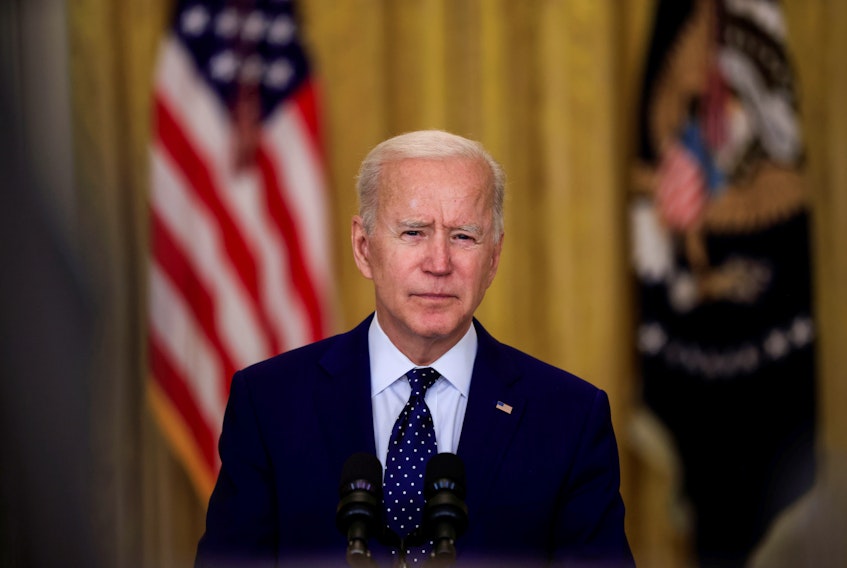
"Even liberal sycophants can’t turn (Joe Biden) into a Franklin Delano Roosevelt, Abraham Lincoln or even Bill Clinton, though they try," writes Henry Srebrnik. - Reuters


On March 25, U.S. President Joe Biden finally held his first press conference. Anyone could see how frail he was. Many newspapers revealed several “cheat sheets” used by Biden, including one with the headshots and names of reporters he planned to call upon.  

The press pool was limited to 25 reporters, and Biden only took questions from a list of journalists whose names and outlets he read from a cue card. He abruptly wrapped up the press conference, telling reporters, “But folks. I’m going,” without allowing follow-up questions.  

Roger Kimball in the March 25 Spectator called it “A tame press conference for a lame president,” where Biden “faced a few mild questions from essentially friendly reporters who were hand-picked by his minders to be sure they were on side.” 

As one (anonymous) critic pointed out, he is, to put it charitably, in “cognitive decline.” In case I’m accused of “ageism,” I’d like to point out that I’m not much younger than Biden. 

So we are left to analyze a video of Biden falling down the stairs of Air Force One or stating that Russian President Vladimir Putin is a “killer” — a word the leader of one powerful country should never use against another, unless willing to break off diplomatic relations or go to war!  

I’d feel sorry for Biden if he had been forced into this job. But he asked for it — literally. 

I’d feel sorry for Biden if he had been forced into this job. But he asked for it — literally. 

Still, his selection as the Democratic party candidate remains a puzzle. The country, mired in a pandemic, mutual hatred between Democrats and Republicans, and serious ethnic tensions, needs strong leadership. Instead, it got Biden. 

Even liberal sycophants can’t turn him into a Franklin Delano Roosevelt, Abraham Lincoln or even Bill Clinton, though they try. One puff piece, a March 26 Politico article, “Why Joe Biden is embracing his age,” by Michael Kruse, hoped he might “ultimately rank among the most consequential of modern presidents.” 

British author Rana Dasgupta, in “The Silenced Majority,” published in the December 2020 issue of Harper’s magazine, asserts that the real political battle in America today is that “between the people and a grandiose private system of social, economic, and political management that has the power to bring to an end the democratic certainties on which Americans have come to rely.” 

America’s ruling circles show disdain for the rest of the country. Since most of the “oligarchs,” as they’d be called elsewhere, support the Democrats, they had no qualms about putting Biden in the White House. Others will shape actual policy. 

The Democrats perpetrated a fraud on the American people and sold them a bill of goods. Other presidents have also become ill, but only after many years in the White House — Woodrow Wilson and Ronald Reagan towards the end of their second terms, Franklin Roosevelt after 12 years in office. 

Biden was simply a placeholder because the party insiders didn’t want those whom most of their supporters preferred: for some, it was Kamala Harris, for others Bernie Sanders or Elizabeth Warren. 

It made a mockery of the whole primary process, too. That simply came to an abrupt end. 

In their book Lucky: How Joe Biden Barely Won the Presidency, journalists Jonathan Allen and Amie Pares describe the concerns that some Democrats had last summer about him.  

Back in April 2019, when Biden announced he was running, he wasn’t an obvious favourite in a crowded field of Democratic aspirants. During the early days of his campaign, he was rambling and repeating himself more than ever. 

Allen and Parnes even quote a staffer who worried about the optics of Biden sitting in his basement during the summer: It looked, he remarked, as if he were in hiding. 

The election was indeed “stolen,” not via fraudulent voting, but by the very choice of the candidate. Surprisingly, at his press conference, Biden told the reporters he was willing to run for a second term — at which point he’d be almost 82 years old. That won’t happen. 


Tuesday, April 20, 2021

Oligarchs Remain in Control of Ukraine Despite Democratization

By Henry Srebrnik, [Charlottetown, PEI] Guardian

 The media, which since 2016 has seen Russia as the bad old “bear” attempting to destabilize and bully its neighbours, paints countries on Moscow’s borders as heroic states fighting to preserve their freedom.

Typical was an article by Michelle Goldberg in the New York Times of Oct. 15, 2019, referring to post-2014 Ukraine, after evicting its pro-Moscow president Viktor Yanukovych in the “Maidan Revolution, as “a remarkably vibrant, multiethnic democracy in a region full of aggressive nationalism and authoritarian backsliding.”

This “narrative” allows the United States to use Ukraine as a staging ground to contain Russian interests in the region, including Moscow’s legitimate concern for ethnic Russians and pro-Russian Ukrainians in the eastern part of the country.

On April 1, NATO said it was concerned about a Russian military build-up near Ukraine’s borders, and U.S. President Joe Biden affirmed the United States’ unwavering support for Ukraine’s sovereignty and territorial integrity.

A few days later, Ukrainian President Volodymyr Zelensky reiterated Kyiv’s desire to be admitted to NATO, something which Moscow has repeatedly warned against over the years, threatening that it could catapult the region toward a major war.

The distance from the eastern Ukrainian border to Volgograd is less than 370 kilometres. Were Ukraine to become a NATO member, the alliance would extend almost as far east as Hitler’s troops had reached when they advanced towards what was then Stalingrad in late 1942. Russia cannot countenance this.

Is Ukraine a state we should go to war over? It remains far from having a democratic political culture – no surprise, since it was part of a totalitarian Soviet Union for 75 years, and prior to that an autocratic tsarist Russian empire.

Instead of transitioning to a new era, it often feels as if Ukraine is stuck in a state of permanent stagnation, living from crisis to crisis and revolution to revolution. Meanwhile, the population remains mired in poverty.

There is no consensus about the exact reasons why success has eluded Ukraine for the past three decades. However, few would argue that the main obstacles have included the excessive influence of Ukraine’s oligarchs.

The classical definition of oligarchy, the rule of a few self-interested elites, denotes entrepreneurs who use their wealth to exert political influence. The concept is also closely associated with political corruption and kleptocracy. It can co-exist with formally democratic systems.            

Since the dissolution of the Soviet Union in 1991, oligarchs have become a central feature in Ukrainian politics no matter what president or political regime assumed power. Though Ukraine has had five presidents since independence, the political entrenchment of oligarchs has remained constant.

They continue to exercise a tight grip on the Ukraine’s political and economic life. Ukraine’s oligarchs typically exercise their influence through corrupt parliamentarians, members of government, law enforcement officers, and judges.

The roots of Ukraine’s “oligarchic democracy” can be traced back to the 1994-2004 presidency of Leonid Kuchma, when today’s power brokers first established their informal empires. Ukraine has undergone two pro-democracy revolutions since then, yet little has actually changed.

          After the Soviet Union collapsed, Ukraine inherited large enterprises, institutions and organizations. Concerns arose about who should own and manage them, thus the process of privatization begun.

The goal was intended to create a competitive business environment. But former Soviet-era apparatchiks saw it as an opportunity to reinvent themselves as political actors to expand opportunities for large-scale profiteering.

The balance of forces between the different oligarchic groups has changed several times but the essence of the system itself remains the same. Oligarchs continue to shape the trajectory of the nation, some choosing to gain formal political offices – this was the case when billionaire Petro Poroshenko was elected president in 2014 -- while others acquired media holdings offering them the opportunity to influence public opinion on political issues.

They use their control over groups of parliamentary deputies to block attempts at reform. When Zelensky won the presidency in 2019, he promised to free the political system of domination by the oligarchs but he has made only limited headway.

A $5 billion loan deal from the International Monetary Fund is on hold as the Ukrainians try to convince IMF officials that they are serious about tackling corruption.